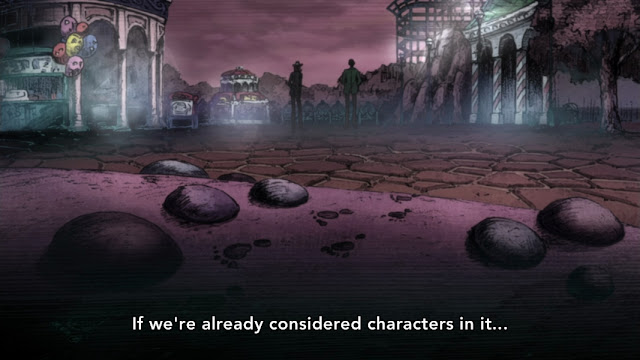
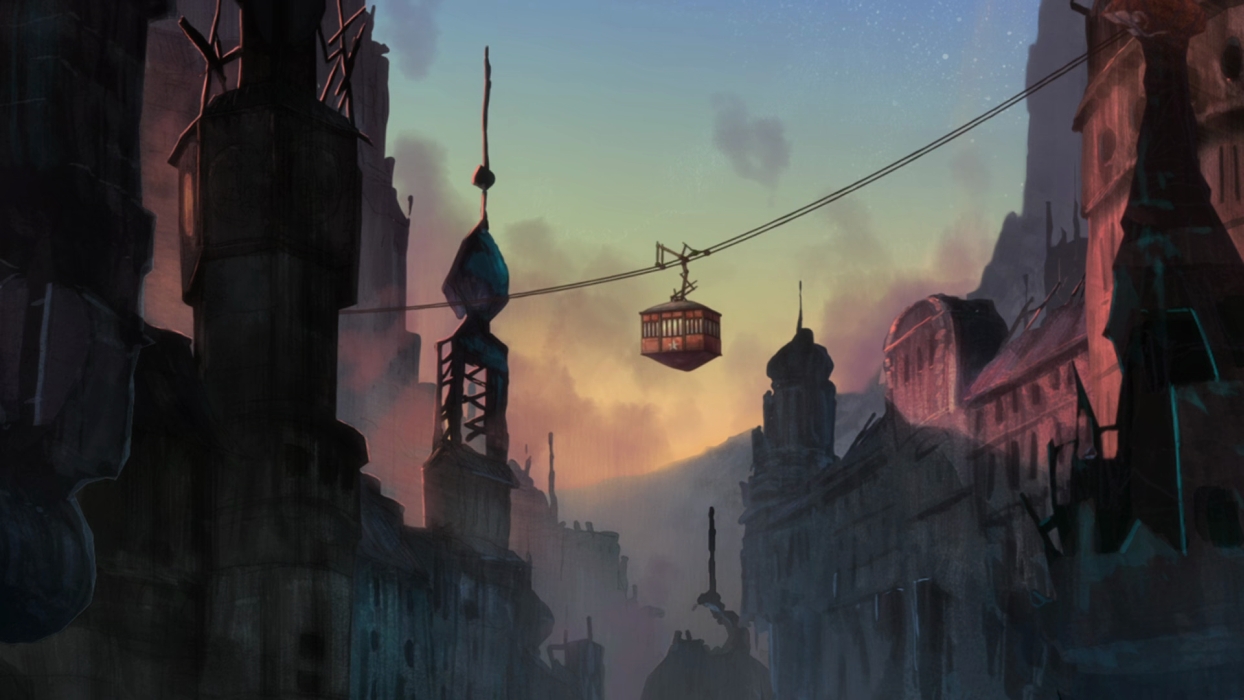
What if we take one the most shameless, brazen, dangerous female criminals in anime history and make her unexpectedly broken, lost, lonely and fragile?
What if we make the main characters of 'Lupin III' second to her?
What if we add another character to futher deepen the dramatic side of our series?
What if we introduce one plot twist after another so that our viewers keep getting surprised?
A decadent 'Lupin the Third'. Overboard decadent.
If we do so, we get a show that leaves us with one quesiton: what does Lupin have to do with all of it?
Actually, it looks like he knows just how out of place 'Lupin' as a franchise is in this twist. And no brilliant voice actor can chage this fact.
Like a jedi coming to help Frodo. Like Chaplin singing Chinese opera.
I mean, half the time it's Fujiko being...
And half the time it's all right. Fujiko being Fujiko. And Lupin being Lupin. And everyone else being just themselves.
Wait, she's actually not broken? She claims to always have been herself?
Well, if it were so, we wouldn't have this series.
You can stitch up black and white together. But not if you keep placing them perpendicularly to each other.
If I said that 'Space Dandy' is something from outer space, would it sound like a very cheap pun?
If I didn't, would I ever do it justice?
If the villain's ship did not look the way it does, would 'Space Dandy' be better?
Or would it be better if there weren't those episodes dealing with life and death, 2- and 4-dimensional universes, space and time, love and dreams, other planets and other possibilities?
If you were offered to become a god with no body, live forever and observe the universe, would you agree?
If you met Shinichiro Watanabe in person, would you tell him he needs to stop making these anime series with open endings?
If I were asked what anime to recommend for a young boy, I would be in a puzzle. But ask me what a young girl may watch, and I have a ready list of anime series for all tastes - from anime adaptations of tales and children's books to new takes on classic fairy-tales and completely original slice-of-life stories.
Would 'Shugo Chara' be in that list? I doubt. At least I didn't expect to see a 'PG - children' rating for an anime which goes beyond kabe-don scenes and scenes of 'he caught her when she was falling', introducing scenes of ear-biting, ice-cream licking, which don't really look vague at all, to say nothing of cross-dressing and a girl with a brother-complex kissing her brother in the lips.
I mean, this 'inserting a key into a lock' moment... Should it really be so obvious?
Unfortunately, 'Shugo chara' lacks originality in everything. This idea of a girl with a special ability to purify spirits, this search for a special something that has unique powers and can grant wishes, this school club that has a secret mission, and, as if these qualities were connected, a glass orangery with a small tea table.
This
is a warning to all anime directors on Earth: attempts to make short
anime out of long ongoing manga maybe more or less successful, but any
attempt to make an anime series longer than it could be if it followed
its manga source - be damned.
I've
seen it already in anime like 'Sugar Sugar Rune' or 'Kamikaze Kaitou
Jeanne'. Filling anime with fillers, forgive me this tautology, makes it
hardly watchable. 51 episodes were probably tolerable, but 51 episodes
followed by 51 episodes, which were, in their turn, followed by 25
episodes nobody really asked for, were a disaster, not only because
there were so many, but because there was hardly any story in them.
Compare with Sailor Moon, which has its own share of fillers, but
manages to present an exciting, developing (sic!) story including not one, but 5 arcs, while being 200 episodes long.
Why I didn't rate 'Shugo chara' as 1, or 'appalling', and gave it an 'average' 5, is because it was partially watchable, these watchable parts being the comic relief of moments that could otherwise overburden me with Spanish shame. Talking about saving the world is watered down by simplistic reasoning.
Discussing serious matters is interrupted by an angel adjusting her halo.
And 'dokidoki' moments are watered down by discussing the realistic aspects of 'hiza-makura'.
It never hurts to have just a little self-mockery.
In fact, 'Shugo chara' had much more potential than was used, thanks to the wonderful character design done by the original manga creators. Girls could find many various designs, not only girly frilly dresses or Japanese kimono, but also signature leg warmers, chokers and wristbands, with plaid pattern and 'Gothic' elements. As for men's fashion... I think I may have been missing slender guys in leather.
The only good thing 'Shugo chara' introduced, in contrast to borrowing from manga, was voice acting, since music was very, very secondhand. I was almost ashamed such nice seiyuus spent so much time voicing this nonsense. Here is the list: Aki Toyosaki, Saeko Chiba, Kanae Itou, Kana Asumi, Nana Mizuki, Yuuichi Nakamura, Akemi Kanda, Ayumi Fujimura, Junko Minagawa, Rie Kugimiya, Atsushi Abe, Mitsuki Saiga and many others. Akira Ishida was probably still bound by his contract of 'voicing a hundred of 'mystery-man-who's-watching-over-the-main-characters'. Not that I consider any of them my favourite seiyuus of all times, but they are good when together, creating that atmosphere of happiness, which was so abundant in 00s. Maybe they weren't absolutely special like older seiyuus I admire, but they have become kind of 'silver age' for me. The only exception was my beloved Miyuki Sawashiro. She stands out whenever she is involved. Even before I realised it was her, I was captivated by that voice.
In fact, that may be the reason why Yoru, the cute cat-resembling 'guarding character', became my favourite character out of all. I could literally give anything to stop this guy making such a sad face.
P. S.
I remember some maitres of anime describing how young animators should come out into the world and look at as many things as possible to be able to draw them naturally. Well, out of all animators who created 'Shugo chara' only one seems to know what violin looks like when played. And that is despite the fact that violin is not just an item for a single episode, but an important recurring theme.
A whole month before I start watching ‘Mushishi’ (and not even having
any plans to do so), I spend time idly flipping channels in a Japanese
hotel and find myself laughing at ‘Chico Will Scold You’. Suddenly Chico
asks her guests if they know what kind of ‘insects’ send Japanese
people insights or keep them unable to calm down as in idioms 虫が知らせる or
虫がおさまらない. https://xn--h9jua5ezakf0c3qner030b.com/5685.html
It turns out ‘insects’ were a new way for the first doctors in ancient
Japan to explain the pathogens causing illnesses or conditions, as
opposed to ‘demons’, which were previously considered the main cause,
and, being demons, could only be dealt with by purifying with the help
of priests. With time, they evolved into imaginary creatures and stayed in the language only.
These are the ‘mushi’ showed in the program as examples:
And there are the ‘mushi’ from the constantly repeated ‘Mushishi’ introduction:
Isn’t such an ‘insect’ a perfect choice to base a whole manga story on?
Of course, simply incriminating ‘insects’ with illnesses would not do.
So in ‘Mushishi’, they are expanded to be another form of life, not
harmful by nature, and existing as if to remind us of simple things.
If you don’t want to lose hearing, don't forget to clean your ears.
If you don’t want to lose sight, don’t look at bright objects for too long.
If you don’t want to lose your memory and fall victim to dementia, try
to go out, meet people and memorise new things little by little.
If you don’t want to harm your nearest and dearest, or nature, don’t abuse your powers.
If you made a promise, don’t break it.
If you have a mission, complete it.
Why ‘Mushishi’ is so impressive is because it’s the rare example of
bringing forward the famous Japanese concepts in a beautiful way that is not a simplification but rather making them understandable.
'wabi-sabi' - without making it too philosophical
the 'mono-no-aware' concept - without making
it too obvious
and the ‘accepting the inevitable’ - without making it
so disgusting
Western heroes, walking in big strides and making superhuman efforts
to win the fight with their fate, are more understandable to us. The need to
comply and follow the flow is against the wishes of our burning hearts.
Seeing a hero who gives up usually makes us despise them. In ‘Mushishi’,
however, the need to comply is natural, following the flow is a way
to survive, and accepting the inevitable is necessary, but not the worst
evil.
‘Mushishi’ manages to make the ‘sad beauty of things’ beautiful enough to look at, and almost tangible, like a museum which allows the visitors to take an ancient treasure in their hands and feel what it's like.
While the word ‘mushi’ is even used in the title, this is, of course,
not a story about strange creatures causing problems, but people and
their relationships and interactions.
Keeping in touch with your family, even after death. Severing ties with
your family for good. Banishing someone from the community because of
the trouble they bring. Helping and saving your community despite being
banished. Killing your family member for the sake of the community.
Killing someone from the community for the sake of your family.
And, as intermezzos, Ginko walking through different places in
different regions, always showing what’s sacred for the Japanese - mountains
the sources of life with their wildlife, clear water
in springs, valleys of ‘satoyama’ and spiritual residences of the
mountain gods
and sometimes - the sea, sources of life, giving people fish, pearls, salt and winds, creating 'satoumi' harbours
A whole month before I start watching 'Mushishi' I find a translation
contest in which an excerpt from Yoshikichi Furui’s ‘Crossroads’ is
offered as a task. I start translating but the work won’t progress and
the process is tedious.
Then I open the soundtrack for ‘Mushishi’ and press play. Suddenly the
mountains surrounding the crossroads in the book become green just as
the mountains in ‘Mushishi’, suddenly the rain, real rain outside my
window, sounds just like little chimes used by Toshio Masuda. Suddenly
the tiresome description of tense relationship between the members of
the family becomes interesting to translate. Suddenly the sadness
becomes beautiful, if not for me - then at least for my future reader.
Could you ever escape falling in love and shedding a tear upon hearing this.
Voiced by a bunch of carefully selected seiyuus who are able to escape from the usual loud exaggerated emotions, accompanied by the beautiful soundtrack, drawn so beautifully, this is the best, if not more, that the mangaka, could with for.
It's sad when an anime turns out to be completely bad and not worth one's time, but it's also sad when it had potential but didn't live up to it.
This is what happens when you try to make a shounen-harem single-season anime series out of a history textbook, even if that history is a fantasy.
The start was almost good, not least because of the funny gap between the seriousness of the main characters' undertaking and their teenage clumsiness.
It also never hurts to have the creators self-conscious of what they do, and once in a century the silly puns and comments typical for ecchi anime sound fun not because they're fun as they are but because they are so intentionally made to be perceived as your typical ecchi comments.
The epic discussion on the fates of the world, philosophical contemplations on good and evil are easily tolerated when punctuated by out-of-the-blue anime-only developments.
The ending by Arai Akino with her ethereal voice, being a nice counterbalance for the generic shounen-anime energetic song with female vocals, also contributed to the fantasy atmosphere.
I even found myself fascinated by how the development of the world is viewed by our main character, Demon King.
However, the further into the story the more the pace of the series is disrupted. It starts when the creators decide to put a whole year of the characters' lives into one episode #3. Then, in the span of 12 episodes we follow, or at least are supposed to be following, several wars and conflicts, both real and economic, developments and deaths of several major poleis, forming of alliances and church dissents, era-changing inventions such as printing and arbalests, all taking place within only several years.
I don't know if the creators meant this anime as a way to attract students not interested in history otherwise, but Maoyuu looks like a perfect ad: hey do you know there's a new version of a history course, this time with boobs and first-rate voice actors.
Maoyuu constantly doubts whether it's a fantasy shounen or a textbook. Where previously shounen characters would be admiring opponents' new techniques, Maoyuu's characters are amazed at...
And when the swaying gets too strong, there's bound to be resonance, which, in its turn it bound to increase the swaying even more. By the last episode, hardly any character gets enough time to be fully presented, new characters and directions appearing even as the last episode is approaching its 20th minute, and the series end up in a peaceful harem interaction while the world's fate stays undecided.
There are cases when I wish a book was made into an anime, but this is the first time I thought I'd be happy if Maoyuu was a proper book rather than a single-season shounen harem.
p. s. Reviving my 'how to learn Japanese' column, I highly recommend to stay away from Maoyuu if you're still in the early stages of learning the language. At least for me, Maoyuu became a source of an infinite despair because of my sheer ignorance of all the Japanese lingo pertaining to economics, politics, warfare and such.
Just the other day I noticed an Indian TV-drama being aired on one of our popular channels that targets young and emotional teenage girls. You know what it's like, right? Every phrase is followed by a row of close-ups showing how every character reacts, or even more, they may start saying something one by one.
Ugh... Japanese TV-dramas and anime are not that bad, but I kinda felt there's something similar in the way they drag the story and make it last several month without anything actually happening.
story and characters
When my friend, a serious grown-up woman of 24 years, just like me, told me she started watching Naruto, I could not understand how that could be possible, but she answered that at least she can turn off her brain and purely enjoy it as a standard shounen story from 00-s. But the next time we discussed it, this is what she said: 'you know, they just show every character for several seconds, or repeat key words of the scene several times, then you look at the timeline and see that half of the episode is already over.'
Let's face reality, pretending these moments are really that important requires being no more than 10 years old and dreaming of becoming a princess in the future. I'm slightly older than that, and I cannot really close my eyes to that. I mean you srsly want me to watch how a guy runs through the corridor, falls down simply because he is in a hurry, even though there is nothing on the floor, inserts a CD into the player and it starts glowing only because the song recorded on it is supposed to be beautiful?
Or admire how manly the prince looks with his gothic guitar?
I mean, the more I watched, the more I wanted a pickled cucumber. 'Cause it's so rainbow-coloured I'm almost blind now.
So, this is a reverse harem, a genre I genuinely despise. Why on Earth did I decide to watch something like this? I hoped that it would be slightly better than those usual stories where the Heroine always cries, gets captured and just refuses to become useful in any possible way. And it's true, our Heroine here is not a damsel in distress, she's a sincere, loyal and hard-working girl who even studied sheet music in a day or so when she realised she won't get anywhere if she does not. Not that trope when an overly positive heroine manages to get along somehow only by her mood and help from others. Though I must admit Nanami is the usual
and she's constantly praised by others 'cause
which alone makes me want to eat a pickled cucumber again, at least she studies in the academy and after graduating starts working diligently, using her ability to communicate with different kinds of people and studying their nature for the sake of creating music specially for them.
So, everybody around her is kind and caring, even though they may sometimes look cold. And they sing everywhere. Green meadows near her rural hometown? Okay!
It wouldn't be thrilling if the harem and the Heroine were separated too much, so they live together even after graduation, in an ordinary Japanese dormitory.
My bad, it was 'dormitry'.
So, what's the story about? I can't tell even after I watched it. But it's something like a fairy-tale.
One of the popular comedy sketches on Soviet TV was a parody on how documentary reports were created at the time. In it, a reporter approaches a man sitting on a bench in a park, and accidentally he turns out to have been recognised a top performer at his workplace, then he mentions his son is currently in the army and accidentally the son comes and greets him saying he has just returned from the Far East, and finally, when he mentions he can play musical instruments, accidentally there is a grand piano in the bushes so he can play it right away. The phrase 'grand piano in the bushes' has since become a symbol of developments that are supposed to be accidental but are just a bit too convenient for the story for the audience to believe in.
If not a piano in the bushes, then at least a guitar on the street.
And, the story is very romantic. Is supposed to be... They probably thought I'd swoon upon hearing such words.
That's the end. My heart is totally captured by such gallantry.
Okay. Does this receive any development? 'Cause in half of harem anime the Heroine does not make any choice until the very end, and even if she does, it does not make the story any more successful - I'll never ever change my mind about 'Fushigi Yuugi' or 'Skip Beat', they are both extreme in creating a world full of pink-coloured snivel.
So, in UtaPri Nanami does not explicitly choose anyone, but it's obvious that one character was chosen as the main one. So,
NOTHING. I TELL YA HE DIDN'T EVEN ATTEMPT. He just went to the summer festival and caught her a carp. Oh, and then he comforted her when she cried. Who said UtaPri would be romance? No-no-no. If you need romance, go and play the game. By the way, it's just what I'm going to do 'cause I'll not let this go until I make sure Nanami ends up with Tokiya.
By the way, I was probably supposed to be touched by such an emotional scene
but, chewing a pickled cucumber since I cannot endure this sweetness anymore, I can only say that I noticed how graphics changed for the better with every new season.
graphics
Well, that is probably what Mr. Oozuka was talking about. This is the case when animators were drawing beautiful faces and with nice lines, trying to make everything look as fairy-talish as possible. And though sometimes I can endure a less beautiful graphics for the sake of an interesting story, I'm generally not actually against a more refined style.
The backgrounds were sometimes really impressive
But here you reap what you sow. If Oozuka-sensei made his characters too simple but paid attention to their movements, moving objects in UtaPri are lacking natural smoothness and look really amateurish. No, you won't convince me it's all right. This is probably the most hilarious moment illustrating the quality of the video.
Just before the third season the creators probably realised that it looks unnatural themselves and made the characters 3D. Not a good decision either.
It's obvious they wanted to make their characters move like they do in Japanese boys bands, but I'm not actually sure if it was a good idea. You can just turn off the sound in the ending video and turn on a random song by a random Johnies band, or vice versa. 'Yeah yeah doki doki flavor', says the preview of this Hey Say Jump song, but it could be a line from Starish's song with an equal probability.
music
If the anime is called 'the princes of singing', then at least can you hope for a good OST and image songs? A rhetorical question.
The problem is, half of the songs is extremely dull and boring, especially those accompanying some emotional moments, like
while the other half was better than average, both image songs and background music. I'd say some pieces were even impressive, especially when we take into account it's not an anime emphasising music (oh let's be honest it's not). As expected, it sparked an row of fan-playing on YT.
And it would be even better if the all seiyuus were good at singing, but most of them were obvisouly chosen not for their vocals, but for their speaking manner.
voice acting
So many fangirls proclaim their love to the seiyuus singing their songs on Soundcloud that I'm surprised. Okaaaay... Maybe I'm just slightly wrong, but I take pride in my ears, and I can tell you that most of seiyuus cast for UtaPri are mediocre singers. I would understand if it were anything else, but they're supposed to be princes of singing.
If you manage to be cool with that, you can totally enjoy their speaking. Want to introduce your younger siblings or children to the world of Japanese voice acting? Just show them UtaPri. And they'll know the establishment of the current seiyuu world. You can choose whoever you want. And if you don't want anyone for the moment, there'll be more next time. First they added Heavens, then Quartet Night, and if you need MOAR then there are new members in Heavens so that you wouldn't sue the creators for limiting your choice.
It was refreshing to hear Sawashiro again as a cute little girl, just a bit similar to her kawaii mode in Di Gi Charat. I was also surprised to hear Imai Yuka's voice, she made a very memorable character out of her not-so-important-heroine's-best-friend.
And those teachers and agencies presidents... Oh my goddable!? Just when did I become a person who's not bothered by a guy wearing female clothes and saying 'good-morning-PUUU!' as a greeting???
conclusion
So let's get to the point, why did I watch it to the end? Why am I sad now that I finished watching? The seiyuus. Yes I know this is a cheap fanservice, but I cannot throw stones at them. They created a wonderful atmosphere, and even though there was too much saccharine, the characters really became like one big family. Such atmosphere always makes me forget that I hate reverse harems. And makes me slightly jealous. Makes me want to be a part of such a 'family' myself.
And of course... I couldn't drop because of this:
>____<
If not for that wonderful ability of the Japanese to laugh at themselves and retain a certain degree of soberness, I would have stopped watching anime long ago.
Well, if they didn't have that ability, they wouldn't troll their own characters like this
or admit that the current TV programs where celebrities participate are very superficial and contrived.
p. s.
I JUST CAN'T OMG I feel so embarrassed when I watch this video as if the seiyuus were daincing it themselves...