Showing posts with label interview. Show all posts

05 October 2015

translation - an interview with Kiriya and Miyazawa about 'Man of La Mancha'

Even though I've stopped posting silly congratulations every time my favourite celebrity or character has a birthday, I just could not miss the birthday of Ms. Kiriya. And I kinda aimed to post this translations on the 2nd, but it ended up being more difficult longer than I expected, so it took me more time to finish. Still it may have some mistakes or look untidy at times, but I hope it's readable. Minor details like schedule and photo caps are not translated.
_____
Interview with ‘La Mancha ladies’ – Hiromu Kiriya and Emma Miyazawa Lafleur, from the musical ‘Man of La Mancha’

The new musical ‘Man of La Mancha’ started in Theatre Brava in Osaka.
This year’s new cast for the play has attracted a lot of attention, not without these two ladies who adorned the new version with their performance. We had a chance to talk with Hiromu Kiriya, who played Aldonza, and Emma Miyazawa Lafleur, who played Antonia.
*Stage photos and interview touch upon the play contents, those who wish to watch the play without knowing anything please beware of spoilers*

– ‘Man of La Mancha’ has started! First of all, please tell us about your feelings after the premiere.

Kiriya
When the first performance ended, I felt very excited and thought ‘so, it has finally started!’
The first day is always a very special occasion, I had adrenalin rush, I felt elevated, and I realised once again that my task is to make these high spirits last and to keep my concentration till the last day.
Also, we’re newbies here (laughs). When we start performing on stage, every day brings something new and different from the rehearsal. We need to reflect upon ourselves, and discover new things, and develop ourselves again and again to make our acting even deeper. Okay, next is your turn, Emma!

Miyazawa
On the first day I felt a little relieved, but I also realised how important it is to keep doing my best.
Of course we practiced a lot during rehearsals, but the real setting, stage with a slight tilt, lighting, costumes… I felt that I could not cope with all these things perfectly. I wondered if even after all that rehearsing, being on a real stage can be so different.
However, at the same time I became fully aware of how I want to show my character that has been passed down to me from so many previous generations, which is a very important thing for me. I felt like I finally became able to grasp that freedom that is necessary to make a character ‘mine’. Just like Ms. Kiriya said, every day is full of reflection and discoveries.

– Ms. Kiriya just mentioned that you two are ‘newbies’, which makes you kind of ‘colleagues’ who joined the ‘La Mancha family’ this year.

Kiriya
Actually the difference in our age is very big, but she’s such a serious young woman that I don’t feel any generation gap at all! (laughs)
We chatted with her from the very start… oh, I should have said ‘we had a pleasant conversation’.

Miyazawa
No, no, it’s me who should… (laughs) Actually, when I came to the rehearsal, Ms. Kiriya had been practicng for around one week already, so I just stuck to her like a bur and learned a lot of things from her.

Kiriya
Yes, there were a lot of things we did not know when we first came, but there are so few women in the ‘La Mancha’ cast that our colleagues who had been in the play longer said: ‘We are few, but let’s unite and do our best!’ and greeted us very warmly, with a welcome atmosphere, and the female cast became very strongly united.

– And now let’s hear about ‘The La Mancha ladies’!

Miyazawa
I remember how Kohko (Kohko Arai who played the maid) said ‘All ladies in La Mancha are manly!’

Kiriya
That’s right, they are really like men! (laughs) A lot of characters are very manful. Maybe they just can’t exist among those ruffians if they aren’t like that, they have to be strong enough to be on par with them.

Miyazawa
And there is not a single scene where there would be only females, I guess it’s female rather than make characters who add spice to the story and make it more interesting. That is why inevitably people with strong personalities gather in this performance.

Kiriya
And when those ‘ruffians’ deal with such ladies, they become so caring, complete opposite to what they are usually! (laughs) I just can’t help loving this personality gap!

Miyazawa
It’s true, everybody is so caring! (laughs)

– It feels like I begin to see what ‘The La Mancha family’ is like. (laughs)

When we speak of the central figure in the play, of course it’s him! Mr. Koshiro Matsumoto.

Kiriya
We’re close like members of a theatrical troupe. It’s my third year after I graduated from Takarazuka, and Emma has been in this profession for 2 years, so how should I put it, it has not been long since we entered this world, at least it feels like something new.

– But Ms. Kiriya had a brilliant career of a Top Star previously [in Takarazuka]

Kiriya
Oh, I just wanted to pretend I’m a rookie too! (laughs) But you see, I can say without any doubt it’s the first time I see such a serious company.
Mr. Matsumoto is in the top of our pyramid, and everybody down to the ensemble really faces the same direction. What I said about ourselves, ‘constant reflection and discoveries’, applies to Mr. Koshiro, too, he is the best example of that.
As I myself have been in such a troupe previously, it feels nostalgic and very pleasant. I do think there aren’t many companies where everybody is so united like here. From this prospective, I really think we are able to present a very precious artwork to our audience.

Miyazawa
What makes one feel that he’s in a troupe, is that somebody from the ensemble can become a muleteer later, so one inherits his role from another person. During our harsh rehearsals we are all comrades, and we are all competitors, and I feel that all of us are brought together by Mr. Koshiro.
Even with my short history of performing I can understand that now I am able to experience something that is not easily available for every actor.

– The opportunity to inherit something precious is reverberating with the ‘La Mancha’ story, right?

Kiriya
My story really resembles the story of my character, at least I can say I entered the performance in confusion and gradually became more refined. I felt the same process unfolding during the rehearsals.

– Mr. Koshiro Matsumoto is not only the main performer but also the director of the play. Tell us more about him, please.

Miyazawa
I remember one day Mr. Koshiro was holding an English version of the libretto and asked me, ‘Emma, do you know what this means in English?’ Even though there would be nothing strange if the role that I have rehearsed for more than 1200 times became so stiff that I could say ‘it should be like this and like this only’, he still draws our attention to subtle nuances in the script and makes us change our style. I can say I was impressed by his flexibility.

Kiriya
I cannot but agree. Mr. Koshiro loves the play so dearly and has met and parted with so many people in his life of a performer, he is a personification of the ‘Man of La Mancha’. We cannot possibly compete with him no matter how we try. And still he is very open-minded and treats even newbies like us kindly, and helps us to cope with our naïve problems.

– Please tell us about your roles.

Kiriya
There are a lot of scenes where we face each other one-on-one with Mr. Koshiro, and though I knew from the start I wouldn’t be able to be on par with him, my initial feelings were ‘can I really stand here next to him?’, ‘do I really count as his equal?’ and so on.

Miyazawa
As I have watched a lot of scenes from aside during the rehearsals, I’d like to mention (laughs) that Ms. Kiriya had been really impressive from the very start! So cool!
Your every movement was so beautiful, I know it’s not ‘mie’ pose, but surely it’s impossible to copy. I was so impressed that I literally wanted to applaud in excitement.

Kiriya
But you know, there was some inner conflict within me, still (laughs).
And I wouldn’t be happy if I were only told that I was cool…
I want people to say ‘why, she was sexy!’ too! (laughs)
Well, even if I say that, Aldonza would be just too pitiful if she were weak, living among those muleteers.
I personally wanted to show her as a woman who lives to the fullest in those circumstances.

Miyazawa
That’s true. Even though she lived in poor conditions, we don’t want her to be just poor. I don’t know if our image was influenced too much by the movie with Sophia Loren, but even though she uses her (female) sexiness as her weapon, her appeal is not in that! Cervantes, Don Quixote can see that.
The Aldonza played by Ms. Kiriya was showing a glimpse of Dulcinea right from the start!
That’s why when Don Quixote addresses her as ‘Dulcinea’, you can understand what he is speaking about.
And then there are those muleteers who don’t see that. Of course, their life is not very easy, too, but the image of a person that they see and the image that Don Quixote sees are very distinct and that’s so wonderful!
Oh, I am sorry, I became a little heated (laughs).
And also, Ms. Kiriya, your sexy parts were sexy enough!

Kiriya
Oh thank you, you’re so considerate (laughs).
Your character, Antonia, is also very difficult, right?

Miyazawa
She is a curious character. During the rehearsals I was constantly thinking, how should I play Antonia in a way that would be best for the performance?
During the workshops I tried to act as if Antonia, the maid and padre were extremely good people and Carrasco the villain, and next time I tried to act the opposite. And then I realised that when I acted as a good person my acting was very questionable, but when I acted as a bad person I was simply doing whatever I wanted straightforwardly.
Of course the setting of the workshops is an extreme thing, but when I tried to perform in different ways like that, I got a strong feeling that while for Don Quixote Antonia is a villain, she is just trying to survive doing whatever she can.
That’s why I understood that the secret is not to centre on her affections and make Antonia a ‘vicious woman’, but to keep the important balance. With these feelings I was rehearsing every day.

Kiriya
I totally agree. For a woman the only means to survive at that time was to marry a man from a noble family so that she could become a noble woman. If it were Aldonza, she would probably earn for living with hard labour and selling her body, there was no other way for her, and I think others were, too, surviving by clinging to something.
And in such circumstances it’s only natural that relatives would be troubled having such a free-spirited uncle. At first I imagined Antonia to be a role of a ‘noble young girl’, but then when I saw Emma portraying Antonia, she was a level-headed girl saying what she wants straightforwardly, and I couldn’t help sympathising with her: ‘of course she would be bothered by such an uncle’.
So, as for what that ‘something’ everybody clings to is, Cervantes has written about it in his play within a play, in the ‘Man of La Mancha’.
Don Quixote once says: ‘If you just compromise with the world you live in, what will you get?’ However, you can’t live in the real world without compromising anything. There is such a conflict. And what’s appealing in this story is that it does not simply portray the characters as ‘good’ or ‘bad’, but just shows how every of them tries to live in their own circumstances.

Miyazawa
If you watch from the start and then watch about the journey of Don Quixote, you’d be impressed and inspired, but as Antonia I can’t really…

Kiriya
Pursuing your dream freely – of course it’s a wonderful way of life, but… You can’t help thinking about that ‘but’, right?

Miyazawa
Yes! You can’t just search for new adventures every day! That’s what she ends up thinking.
She loves him as her relative, but she can’t help thinking ‘I have my own life, too, you know’.
And when Quixano finally returns home and wants to spend his time peacefully, a strange woman appears before him and makes him remember it all. He doesn’t want to hear about it, but he can’t ignore the fact that something outstanding happens in front of his eyes, there’s nothing else to say.
If one’s family does not support him in pursuing his dream, it must be so painful that I cannot endure imagining it really.

Kiriya
That’s right! Even though this story is about ‘endless dreams’, it does not fail to depict reality very well, too.
In the end of this play the characters go back to their reality, which equals imprisonment, and Cervantes leaves them, so what awaits them in the future? They will stay in prison just like before. When I saw it, I felt like, you know… it’s very cruel.
Maybe the audience, too, will be moved by the story of the man of La Mancha and leave the theatre full with emotions, but the next day they would have to go to work etc.
Of course they would receive energy for living from that play, but they would have to face reality, too. And still, I think something may change inside them, even if just a little. This is surely a play that leaves a strong aftertaste.

Miyazawa
And that’s probably what makes this play different from others. It does not end with the characters escaping from reality, it has something dark in it, and that leaves a very strong impression.

Kiriya
And also, Emma, your character appears on the stage only at some moments, don’t you feel anxious about that?

Miyazawa
I do! There is one highlight scene when I sing, at least it’s an important scene for Antonia, and it comes in the first half of the play, but until that moment I feel extremely anxious! (laughs) And when it ends, I feel a bit relieved…
Though I feel relieved in the same way during our rehearsals, they always take place in front of my eyes, so I can see the rest of the play and share the same atmosphere with those who are engaged in it, but in the real performance [when the scene ends] we go backstage. And from there we must return to the stage where Mr. Koshiro and Ms. Kiriya have created a very tense atmosphere. Being able to enter the stage without breaking that atmosphere, concentrated and keeping the necessary spirit, is a skill that’s difficult to develop. It’s a challenge for me to mobilise myself when needed and to sense the mood, so for me it’s both hard and pleasant to take part in the performance every day.

– It may be a slightly difficult question to answer right away, but what would be your favourite line in ‘Man of La Mancha’, which is a source of many great lines to quote?

*short silence*

Kiriya
Well, I wouldn’t say it’s a phrase I particularly like or dislike, but there is one very difficult phrase that I fight with every day: ‘My name is Dulcinea’, my last words in the play.
Before that I say several times: ‘would you look at me as I really am’, that’s an important thing to notice. And when Aldonza utters ‘My name is Dulcinea’ in the end of the play, if you view her from aside, it’s really astonishing. It’s very difficult to say that phrase with appropriate energy, and in order to pronounce it properly I must live as Aldonza before that with all my might.
There isn’t any established way to say it and there’s no end to it, probably I will think over that phrase until the very closing night.
Emma, how about you?

Miyazawa
It may be a very plain choice, but I’d pick ‘Facts are the enemy of truth’.
It’s a scene where everybody holds their breath. And from that point, the narration of the play changes, too. The spectators may think ‘I was sure he was just a strange old guy, but maybe I could listen to what he says?’, and become aware that there are different ways to view things. After watching the play one realises that it’s not the most important thing to pursue only what is right in front of his eyes.
What’s even more interesting for me in this play, that line alone is pronounced very distinctly. In truth, maybe Alonso Quixana is not as mad as everybody thinks, maybe he’s even Cervantes himself. In other words, it’s not Quixana (Quixote) confronting Carrasco, but Cervantes confronting the prisoners.
And while I am thinking about that, he starts to say something about the golden helmet of Mambrino.
And there’s the scene with ‘nobody but you sees it!’ (laughs)

Kiriya
When we saw this scene for the first time, we all talked about how wonderful it was.
Unexpected to themselves, the muleteers start singing with him, or start crying because of emotional movement. It’s a very funny scene, but everybody starts to follow Don Quixote before they even know it. It is a wonderful and interesting point about this play.

Miyazawa
It's not what you say, but how you say it, right? I thought that it must be how charismatic people get others involved in their adventures.

Kiriya
Also, Don Quixote gets a dirty cloth from Aldonza as a memento of his lady Dulcinea, and in the scene with the helmet of Mambrino he attaches it to his helmet to mark it.
Everybody says it smells, but Don Quixote at first says ‘what a wonderful aroma!’
Has his sense of smell gone bad, or does he feel that the smell is pleasant because he adores his lady so much? Which one is true? It’s a scene that only gets more interesting the more you watch it.

Miyazawa
Yes, that’s what makes the play so interesting because you discover it when you see it for the second or for the third time.

– You seem to love this play even as spectators, not only as actresses taking part in it!

Kiriya
Speaking about the audience, after Aldonza is violated by muleteers, she sings a song expressing her pain, and there are times when she receives a lot of applause and when she does not. I myself always end up thinking ‘you needn’t really to applaud that much!’ (laughs), because within the story it’s a very shocking development that makes you say ‘what?!’.

Miyazawa
That’s because you would want to applaud the person who sings, but you cannot applaud what occurred. There are times when people applaud and when they don’t, but I feel I can understand the feelings of both.

Kiriya
That’s right, it’s not like one of those reactions is right and the other isn’t, it’s just that I feel the one when the audience is taken aback by what happens is even more ‘real’ [than when they applaud]. Both of them are possible, and the atmosphere is completely different in these two situations.

Miyazawa
Sometimes I think ‘today’s audience is unusually silent’, but then at the curtain call they start applauding vigorously, or even give us a standing ovation.
Then I understand that they have just been deeply immersed into the story.

Kiriya
This story is a play within a play, so everyone who watches it is a prisoner, and everyone listens to the Cervantes’s story. When the story goes from the play within a play back to reality (which equals prison) the audience may relax, and the atmosphere in the hall changes suddenly. That’s what I understood after the curtain went up.
It’s a thing Mr. Koshiro was always saying, too, but now I understand myself that the play is complete only when it has spectators.

– So, please tell us again what the appeal of 'Man of La Mancha' is as you see it, being members of the 'La Mancha family'.

Kiriya
I know it must sound strange because I'm one of the actors here, but this performance is well done. It’s so good that I want to see it from a seat in the audience. (laughs)

Miyazawa
That’s true! I felt the same way during rehearsals, and even though I must confess I'm not the type who watches the same scene again and again, it’s interesting to watch 'La Mancha’ many times. Now I feel like the two of us are promoting the play here (laughs), but sometimes I make discoveries like ‘so that's what it means!' or 'today the dialogue's timing is different!'.

Kiriya
Of course there is the appeal of this play that has been staged so many times, but I feel deeply that it's also important that it is still changing. Our ‘naïve problems’ of actresses who have just joined the company are welcome here. They tell us not to hesitate to express our vision so that they could think over things that have become natural for them since they have been acting in this play for such a long time, and so that they could bring something new into it. It’s praiseworthy that their stance is to make the performance even better with the help of the new cast that they are having now, at this moment.

Miyazawa
Yes, it’s so great! The troupe of 'La Mancha’ is great because it can boast both long history and flexibility, because it accepts different points of view.

– And at last, please leave a message for fans of ‘Man of La Mancha’ and for those who haven’t seen it yet.

Miyazawa
I have heard opinions that ‘La Mancha’ is difficult, but the truth is, its story is very simple.
When you hear such words as ‘medieval Spain', 'wandering knight', ‘Inquisition’, you may think for a moment that you’ll have trouble with understanding the contents, but in this play the story moves forward without fixating too much on such matters. If you hesitate whether to watch this play or not because it seems difficult, then rest assured, you can enjoy it without any worries.

Kiriya
This work describes different people and their way of living, being based on an old book that has been recognised as one of the greatest literary works. We are new to this play, but I feel great meaning in the fact that I have been able to become a part of it. I feel that my spirit of a performer has been tempered in ‘La Mancha’, so I want to keep acting with pride, and the source of such determination is the presence of Cervantes, of Mr. Koshiro.

Miyazawa
When he is with you on the stage, nobody can be lazy in his acting, right?
Leaving the question whether he does it well or not aside, everybody wants to become even better and rise on the same high level, nobody would want to drag down his partner.

Kiriya
And in this manner our performance will develop up until the closing night, so I’d be happy if you come to watch it, maybe even several times.

– Thank you very much! Now the next performance seems even more interesting and attractive.

Mss. Kiriya and Emma let us speak with them even though they were tired after their first performance, and the interview progressed very lively.
Having their own opinions and loving the play deeply, they became even more eager to talk when we touched upon the subject of the play, the cast and the roles of their respective characters.
We can surely look forward to their future projects, which will be even more interesting now that they have taken part in such a play as ‘Man of La Mancha'.

10 July 2012

translation. an article about 'The Man from Algiers' and 'Dance Romanesque'

after watching 'Hakushaku to Yousei' I was pretty sure I better keep a distance from everybody - I was afraid I might kill someone. as I am certainly spitting poison. my whole body is intoxicated with sugarish shoujo. 'tis a rare case for me, to feel THIS bad after shoujo. the last time was, perhaps, when I read Saitou Chiho's and Higuri Yuu's works
I needed something to occupy myself with, and at the same time - something soothing. and what can be better than translating another article about Moon Troupe in such a case?

Takarazuka Revue Moon Troupe Performance -  'The Man from Algiers' and 'Dance Romanesque' - first day interview
link
Musical Roman 'The Man from Algiers'
Author: Shibata Yukihiro. Director: Oono Takuji
This is a revival of a play that was first performed in n 1974 with Ootori Ran playing the main role, and performed again in 1983 starring Mine Saori.
It tells us about a young man with ambitions who wants to climb up the road of success so much that he even uses the girls who gave their hearts to him. Youth is only half sparkling, the reverse side of it brings a cruel shadow with it. This performance attracts us to the described man.
Three girls who make their way through a sad destiny. A splendid work that portrays the dramatic lives of young people, burning with hopes.
Show Spectacle 'Dance Romanesque'
Director: Nakamura Satoru
'Romanesque' has a meaning of something like 'with refined taste' and 'passionate'. 'Dance turns a single moment into eternity' - with this theme laid as a basis, the group dancing filled with youthfulness and liveliness, dances with stories, composed of dances of different styles, this show is overflown with passion and energetic movement.

Report
On September 16th, 2011, an opening day interview was held.
Kiriya Hiromu
I am grateful you all gathered here on such a hot day.
As for Moon Troupe, though we have been delivering happy ending stories for a long time, now we offer a very tragic story, but this play is overflown with Shibata Yukihiro's (author) roman, and the show will be refreshing and interesting, so the performance will be a characteristic Takarazuka double feature. We will do our best in delivering it to you until October 16th, so we would like to count on your support.
Aono Yuki
The play will be a tragedy, and the show will be enjoyable. With the present power of Moon Troupe we will put all our might into the performance, so we would like to count on your support.


The impression of members of Moon Troupe energetically dancing from the very beginning of 'The Man from Algiers' to the very end of 'Dance Romanesque' is very strong, but isn't there some scene that you particularly like?

Kiriya Hiromu
The opening of 'The Man from Algiers' is the first modern thing in a long time for Moon Troupe, so we were wearing suits and dresses that are easy to move in, and this is a thing I have done many times in my underclassman era, but this time I play a character who is a glittering with ambition carnivorous man (the words may sound a bit old... *laughs*), which is the first time in a while, and I particularly like the dance in the prologue of the play.

Aono Yuki
There is a very adult-like dance in the show I am honoured to dance, where I wear a white dress with spangles, and since this is the first duet dance with such a feeling, though it is a challenge, I will do my best to cope with it.

Kiriya Hiromu
And there are also different kinds of wigs.

Aono Yuki
I use four kinds of them.


What are the interesting points of the musical in your opinion?

Kiriya Hiromu
The show starts in a very energetic way, with high tension, and then a lot of scenes follow which have a story in them, but I hope the audience will have a feeling of satisfaction after a scene of Notre Dame de Paris, as if they had seen all the acts, and I will be glad if they feel the drama. Though in a show it is always necessary to deliver the dances and the songs with energy, this time we enter the fourth piece, and I hope we can deliver every single scene with its deep contents.

Aono Yuki
In the musical ms Kiriya plays a man overflown with ambitions and all, but there are 3 girls who are involved with him, so the interesting point is that he is such an attractive man...

Kiriya Hiromu
A concealed pressure? (laugs)

Aono Yuki
No, not like that (laughs), just the male roles are greatly portrayed. Also, there is a difference between the scenes in Algiers and in Paris, so I think the audience will be able to feel the image of those days.
_____
notes
  1. I have no idea what is meant by 4作目 which I translated as 'the fourth piece'. really, who 'we' and what is the fourth? I might be stupid but I am at a loss...
  2. I want a video of this. guess I have something to occupy myself with from now on... searching for interview videos... MB 'tis in some of the cafe breaks? or something...

20 June 2012

translation! ~ one more article about Kiriya-sama retiring

this morning I noticed one thing. I haven't been translating anything for a while. translations I do for my works do not count. I mean, something interesting, like Zuka-related stuff or songs lyrics...
when in university, I had some classes I was not eager to attend, but those were necessary, so I occupied myself with articles translations. not I am enjoying my vacations - and where's the result??? I have translated nothing useful or interesting, though not only articles from web-newspapers - HUGE amounts of interviews and articles in the magazines I bought are waiting for me. to say nothing of scanning... >_______< somebody make me work hard!

this time I want to translate an article about guess who???
*a failed attempt to surprise my readers*
ok, ok. this article
is about the last day of Edward 8 and Misty Station in Tokyo Takarazuka Theatre. most of the contents I already translated using the article from the official website, so this time I only provide those paragraphs which are different from the official report. perhaps, Zuka masukomi staff think that Zuka fans should be able to grasp the meaning of everything they write without any hints and explanations... well, even I am not able to do this. also, the more I read different newspapers' websites (and the official website of Takarazuka), the more I understand that they decide themselves which words to cut out, and which to leave as they were in the original... which variant was the original is impossible to understand, though
anyway, enterminal really helped me. hope it helps you, too

Q. After you have finished the performance in Takarazuka, once more, what is the place called 'Takarazuka' for you?
A. The very essence of my life is that I have been doing my best with the feeling that I lived for the stage, and I still cannot realize the fact that I will not stand on that stage anymore starting from tomorrow. I have reached today in my 'best condition', running with a feeling of challenging myself, therefore 'Takarazuka' is an irreplaceable thing, and I think from now on I will live on never forgetting this feeling, never losing it.

Q. What are your plans for the future?
A. I haven't decided anything in particular, so I would like to inform you when I do.
 
Q. In the last address you used the words 'Even if the clock were turned back, I would choose the same path.' When and with what feelings did you create it?
A. First, I made an address in the Grand Theatre, which was so close to me even before my enrolment, that was the first part, then I came to Tokyo, but in the everyday life being constantly pressed by the performances, I could not settle my thoughts, so I was thinking from the previous evening till today's morning, and finally decided during the performance itself.
 
Q. After this day has come to an end, when was the moment you clearly realized that it was the retirement? 
 A. The atmosphere of the audience was quite different from before, and the atmosphere of the Theatre was heavy (laughs). But I wanted to persist in acting, and I so I did pushing that feeling aside. Of course, the closing night also happened, but I was able to live this day concentrated on the performance without being washed away by different feelings.
  
Q. Any words you would like to convey to the juniors who are to meet the 100 anniversary of Takarazuka Revue in two years?
A. I cannot say anything too special, but as I already said in my address, there is no other talent than to do your best, I have arrived on this day living like this, so I want to point that doing your best is never in vain, I want you to be proud that you are in such a wonderful world, such a place where you can do your best, and I want you to do your best in challenging yourselves to try all the chances for yourselves.

Q. What is the music that accompanied you descending the Staircase for the address?
A. It was a melody from my debut performance 'Phoenix' to which we performed the rockette dance. One phrase from it is used in the show 'Misty Station', it flows before the scene called 'Daydream', which was an idea of director Saitou Yoshimasa, so those who will notice, will notice, those who won't - won't. By the way, unfortunately, my classmates who attended the performance failed to notice it completely (laughs).

Q. The Farewell show was splendid, but were there any ideas of yours in it?
My ideas... There were a lot of my selfish ideas inserted, and I think the burden on the members of Moon Troupe was also considerable, but the show focused on the performances where I was honoured with the leading part, and the others who retire also got highlight scenes, and the show was created with a lot of recommendations from director Saitou. There was a dance in black tailcoats on the Grand Staircase, and though I think there were no Farewell shows before which went as far, this was the path I have taken, so I was allowed to insert it.

12 May 2012

translation. interview of the Moon Top Combi on the last day of Tokyo performance

the source article
*please PIA don't kill me for stealing your photos...*
*upd 12.04*
well, yes, I was keeping silent during the week, but I was not doing nothing! I had several classes with a lot of free (well, almost free) time, so one article is ready and the other is coming! ^___^


'Our collection'. Farewell show of Takarazuka Moon Star Top Combi, Kiriya Hiromu and Aono Yuki
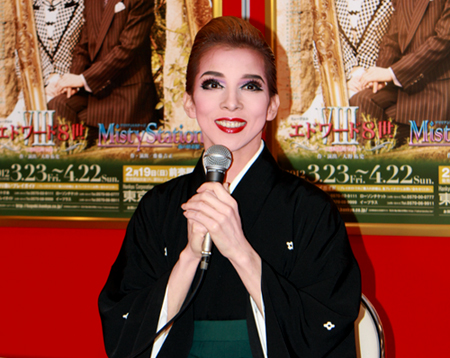
On March 23rd, the curtain was raised for the Tokyo Takarazuka Moon Troupe performance of 'Edward VIII' and 'Misty Station'. This performance will be the last one for the Top Stars Kiriya Hiromu and Aono Yuki. After training on the opening day of the performance they shared their feelings with the reporters .
The performance consisted of two parts, the first being a play 'Edward VIII' describing half of the life of a real British king who was loved by his people, but who abdicated the throne after about a year of reign, the story taking place in England of the XX century, and the second part was a nostalgic show 'Misty Station' based on the motive of travelling by train. 'Edward VIII' which portrayed a 'love that cost the crown' between Edward VIII and American married woman Wallis Simpson, was a dramatic performance, though not overly romantic, but was a very Kiriya-like play showing a lot of wit and smartness, with intellectual and bright characters, which Kiriya matched so well. On the other hand, the scene with the king broadcasting his decision to abdicate the throne was overlapping with the image of Kiriya standing on the top of a kingdom called Takarazuka, who was about to embark on a journey, so the show was a very suitable one. Moreover, the show was created so that the audience would enjoy to their heart's content the charm of Kiriya as an outstanding dancer and singer, and the combination with Aono, who performed in tune with Kiriya.
During the press-conference Kiriya made a short address - 'This is the last performance for the two of us, but because of this very fact I am determined to make a performance which all the guests can enjoy here in Tokyo, not 'anyhow', but the same way as we did before.' Aono also said - 'During the rehearsal before the Tokyo performance I noticed that nothing has changed. I want to do my best and to develop myself to the very end.' About the two parts of the show Kiriya said - 'Though the traditional image of Takarazuka is a male role player standing straight and female role player clinging to him, if I think about us - we were a pair standing together and quarrelling. In reality, it is not as if before this performance Aono would give me advice, or pick up a fight like in the play *laughs*, but these characters are extremely well expressed, so it is very interesting. I want to create a performance that can be called our collection, because a very suitable work was kindly prepared for my last performance.' To that she added her passionate memories of her 18 years of enrollment in a place called Takarazuka - 'When I first attempted to enter Takarazuka, I failed, but I managed to do it the next time. During a year, I was studying hard in order to improve myself, filled with the will to become a male role player here. It is a place I devoted all my passion to, with this only feeling, to the extent that I could almost give my very life. I want to go on moving to the closing night because this feeling does not change.'
_____
translator's remarks
  1. how come they almost read my mind??? the thing I noticed best in 'Edward' as well as in other musicals was that the Top Combi of Moon was completely different from the usual image - and Kiriya-sama repeats it... >___<
  2. the phrase I translated as 'to perform in tune' means literally 'to adjust one's breath', and it can be applied to their Top Combi in both meanings. I chose a more general one, because it suits the text of the article better, but I remember AYAKO, the choreographer of 'Misty Station', describing Aono-sama as a magnificent and skilled dancer who really adjusted her breath to Kiriya-sama so that the Combi had very good timing and synchronicity
  3. I used the usual 'male role player' and 'female role player', but Kiriya-sama used the word 'onnayaku', not 'musumeyaku'. this seems a bit strange for me, because 'tis exactly 'musumeyaku' image which implies a fragile girl standing near strong and tall man, but well, perhaps my dear Kiriya-sama is filled with a sense of justice and equity? ^.^

23 April 2012

interview translation. Ms Kiriya's Tokyo interview about her retirement

the first thing I should do today, of course!
the original article

The interview of Kiriya Hiromu, retiring after the closing night of Tokyo performance
On April, 22nd, Kiriya Hiromu, the Top Star of Moon Troupe, gave an interview on her retiring after the end of musical 'Edward VIII' and brilliance stage 'Misty Station' in Tokyo Takarazuka Theatre.
Kiriya Hiromu
'We have just successfully finished the performance of 'Edward VIII' and 'Misty Station' in Tokyo Takarazuka Theatre. Full of energy, with happy feelings, we were able to see the curtain fall down after the closing night, and now I am full of gratitude and sense of accomplishment. I thank you all for your cheering that I was honoured to receive.'

Q. If you recall the place called 'Takarazuka', what is it like?
A. The very essence of my life is that I have been doing my best with the feeling that I lived for the stage, and I still cannot realize the fact that I will not stand on that stage anymore starting from tomorrow. 'Takarazuka' is an irreplaceable thing, and I think from now on I will live on never forgetting this feeling, never losing it.

Q. The Farewell show was splendid, wasn't it?
A. We created the show having received a lot of recommendations from Saitou-sensei, so that it would be focused on the performances where I played the leading part, and the others who retire also got highlight scenes. There was a dance in black tailcoats on the Grand Staircase, and I think there were no Farewell shows before which went as far, but I wanted to show the path I have taken, so I was allowed to pack it with many things.
Q. The music which accompanied you descending the Staircase for the address?
A. It was a melody of rockette dance in my debut performance 'Phoenix'. One phrase from it is used in the show 'Misty Station' which has just ended.

Q. How and when did you think over your last address?
A. First, I made an address in the Grand Theatre, which was so close to me even before my enrolment, that was the first part, then I came to Tokyo, but in the everyday life being constantly pressed by the performances, I could not settle my thoughts, so I was thinking from the previous evening till today's morning, and finally decided during the performance itself.

Q. After this day has come to an end, the moment when you clearly realized that it is the retirement?
A. The atmosphere of the audience was quite different from before, so I was feeling today was the closing night, but I concentrated on the performance without being washed away by different feelings, and I acted aiming not to be overly worried by the fact of retiring.

Q. When will you have the actual feeling of retiring?
A. From those who already retired I was honoured to hear that it takes approximately one busy month to settle everything and get prepared to the new life, but in two or three months I will probably start feeling lonely.

Q. Any words you would like to convey to the juniors who are to meet the 100 anniversary of Takarazuka Revue in two years?
A. I have arrived on this day having lived with the belief that there is no other talent than to do your best, with the feeling that doing your best is never in vain, so I want you to be proud that you are in such a wonderful place where you can do your best, I want you to do your best in challenging yourselves to try all the chances for yourselves.

_____
translator's remarks
  1.  almost cried at the last words, the address to the young generations...
  2. *upd 27.04* 
changed 'rocket' to 'rockette'. I thought the dance to be a kind of motive of a rocket, as the revue 'Phoenix' uses the theme of other planets and spaceships etc. having read the description I see there were no rocket dances, likely ロケット means rockette, however I have never met any mentioning of rockettes in the interviews of siennes so far, therefore - hard for me to say anything... >___< please forgive my inexperience

06 March 2012

interview translation. Kiriya's last day in Grand Theatre

this time I decided to give up my proper sleep at night. so, I am trying to translate the article
hope my lack of sleeping does not affect the translation...

Interview with Kiriya Hiromu on the closing night of Moon Troupe performance in Takarazuka Grand Theatre
March, 5th, (Monday), was the closing day of the musical 'Edward VIII' -the love that cost him the crown- and brilliant stage 'Misty Station' -the terminal station in fog-.
After the performance ended, an interview concerning retirement was held
Kiriya Hiromu
'Just now, I was honoured to graduate from the Takarazuka Grand Theatre with a feeling of happiness. For me, the Takarazuka Grand Theatre is a 'home ground', and I am full of gratitude to all, for being able to come to finish so lively. I want to head the Tokyo performance polishing my skills even more, so that together with everyone we will creatre a good performance'
Q. Your feelings when you were waiting for today to come?
A. I was wondering, what I would feel heading towards this day, but I felt perfectly self-possessed and happy. The musical, farewell show, greeting, all of these I did with the same mental strain as usual, and I am releived that something is already finished. I felt that I was performing in the closing night show
Q. Reason why you chose hakama and haori for the greeting?
A. I am a male-role player, and a student of Takarazuka at the same time, therefore I decided long ago that I would like to give my greeting being able to wear a hakama for the last time
Q. How was the penlight in the audience during the farewell performance?
A. The audience was beautiful like a sea of stars. It was a moment of happiness, that I was bestowed with a chance to sing in such a space
Q. The moment you thought it was the last moment of standing in Takarazuka Grand Theatre?
A. I was not thinking that it was the last performance while playing, but when it ended and I was receiving applause on the curtain call, I was observing the audience of the theatre and I keenly felt  like 'so, I will never stand here again...'

25 January 2012

Moon Top Combi retirement - translations from the official web-site

somehow I have forgotten to translate the main part of the info considering my beloved Top Combi retirement. I wonder why... I can only suppose it took me a long time to finish the translations from the web-newspapers, so when I finished, I was so happy that I did not check what was ready and what was no
this time I would like to translate the articles which obviously provide the best imformation. well, I daresay they do, as they are from the official web-site...
let me start with Aono-sama


On November, 11th (Tuesday), there was held a press-conference dedicated to the announcement of Moon Troupe Top Female-role Player Aono Yuki retiring after the musical 'Edward VIII' ~The Love that Cost Him the Crown~, and brilliant stage 'Misty Station' (Takarazuka Grand Theatre: from February, 3rd, till March, 5th, 2012, Tokyo Takarazuka Theatre: from March, 23rd, till April, 22nd)

Kobayashi Kouichi (board chairman of Takarazuka Revue)
'After she was transferred to the Moon Troupe to become the Top Female-role player, the true strength she cultivated before blossomed at once, so I think she became a magnificent Top Female-player for us. The Top Combi with Kiriya Hiromu was extraordinately perfect and splendid, so I think, she is an outstanding talent who supported the Moon Troupe and Takarazuka Revue. Until she, whom I described now, graduates on April, 22nd, next year, on the closing day of the Tokyo performance, I humbly beg you to bestow her with your support, so that she shines even more'

Aono Yuki
'On April, 22nd, next year I shall have your permission to graduate from Takarazuka. I want to keep doing my best on the stage until the closing day of the performance, so I humbly beg your support till the end'

Some details which led to the decision to retire? 
'After I was granted with the position of Top Female-role player, I was thinking about the time to retire vaguely, and when I heard of mrs Kiriya retiring, I decided I would like to retire the same time'

something from Kiriya?
'She said to me 'Let us keep training until the last performance the way we did before, in our style''

Any plans after the graduation? 
'I am absolutely not thinking of anything particular. I am absorbed in training with all my might, so when I settle down [after the graduation], I think it would be good if somewhen the time comes when I am able to think over'

The greatest reminiscence about the life in Takarazuka?
'After I was enrolled, I did not have any big dream, but I had a lot of smaller ones, like that I wanted to try this kind of thing. Among them, I was wishing I could participate in a performance abroad, and I remember distinctively the fact that on the 2nd year (the performance in Korea in 2005) I had the permission to participate in such performance'

The role which became a turning point?
'Performing 'Anna Karenina' was the time when I changed as a performer, and as a person, and I am grateful from my very heart that I was bestowed with the role of Anna in that period and timing'
_____
well, I believe this translation to be a little better than the previous ones as I have gained some experience (is it not?), but its content frustrates me. does she really consider her trip abroad and Anna's part the greatest achievements? I am a bit disappointed

29 December 2011

interview translation! - Oozora-sama retiring

The Top Star of the Cosmos Troupe Oozora Yuuhi - press-conference concerning retirement


December, 27th (Tuesday), Cosmos Troupe Top Star Oozora Yuuhi gave an interview concerning the announcement of her retirement after the musical 'Brilliant Days' and grand show 'Climax ~Cry-Max~' (Takarazuka Grand Theatre: from April, 13th, till May, 14th; Tokyo Takarazuka Theater: from June, 1st, till July, 1st, 2012).

Kobayashi Kouichi (the board chairman of Takarazuka Revue)
'The Cosmos Troupe Top Star Oozora Yuuhi decided to graduate from Takarazuka on July, 1st, next year on the final day of the performance in Tokyo Takarazuka Theatre. Before becoming the Top, she experienced different things, gained the true strength, speaking of her, she became a really great male-role player, and as the Top Star of the Cosmos Troupe she contributed to Takarazuka becoming the way it is now, she leads the theatre. Among the 5 troupes' Top Stars she is the only one to have experienced the old performances of Takarazuka, and she is graduating now, so I feel a bit lonely, but until she graduates, as Oozora Yuuhi, I pray you to support her so that she shines more and more'

Oozora Yuuhi
'I shall graduate July, 1st, next year. I would like to thank everybody for having been supporting me for a long time. Until the last day I want to live on the stage as Oozora Yuuhi, as a male-role player, so I hope for your further support'

The reason of the decision to retire?
'After I received the honour to play the leading part, I was bestowed with spending really productive days, but during 'Classico Italiano', 'NICE GUY!!' the stage performer Oozora Yuuhi, a male-role player, seemed to be interesting, I felt the definite feedback, that I was acknowledged, so I thought I can graduate'
A performance or a role that is memorable?
'After I began to play the leading part, all of the roles were memorable. Apart from them, when I was bestowed with the role of Kuraoka Ginshirou from 'Kamata March' ('Gin-chan's Love') as my first challenge, I think the thing I laid my hands on was a big one'
Considering the performance before the retirement
'The performance which I graduate with, is a debut performance (for the 98th class), and the 'Brilliant Days' is a debut of mrs Harada, so I think it will become a very bright and dramatic performance, and as I remember of my own initial intention, I think it would be good to bring to a finish my last performance' 
A message to colleagues
'I was honoured with opportunity to enjoy the world called Takarazuka, the world called male-role playing, and it seems to me, I was only savouring it. The time is different for everyone, but the time spent in Takarazuka was limited, and I think, the fact I put everything in that time will become the supplies of my life. I want you to put all your energy into what you face and live a productive time'
A message to the fans
'You have always, always kindly watched over the clumsy me, and my gratitude cannot be expressed with words. When I struggle for the last time, I think it is my fans who pushed me in the back to playing the leading part. That I am here doing this is also due to my fans, and I thank them with all my heart. I want to receive the honour of being enjoyed by everyone as male-role player, Oozora Yuuhi until the 1st of July, so I pray you to honour me with your support until the end'
_____
translator's notes
  1. I do feel 'tis important to translate not only meaning, but also the style used by siennas. they are always polite, overly polite, pronoucing the unwieldy phrases as if the process is automatic. I personally do adore this feature of theirs, and if you do not, that is absolutely not my problem, as I am strict about myself and I am perfectly sure my kind of translation doth not affect the meaning as well
  2. Oozora-sama named mrs Harada as 'Harada-sensei' (of course, she's a director), and as I am not going to leave the suffixes (and BTW I am against 'Gin-chan's love' as the English translation) in translations, any ideas of how to replace the 'sensei' suffix would be appreciated
  3. yes I am controversial myself, as I do use suffixes, but that's a habit of mine that cannot be erased, and I consider it tolerable while speaking myself, not translating