23 August 2018

IMHO. 'Suki tte ii na yo' ~ 18 volumes are not the same every time

I think I know several shoujo manga approximately 18 volumes long, sometimes a bit shorter, like 15, or a bit more than 20. I think I understand to some extent what the story would be like with such a length. And I know what one can make out of such manga creating a 13-episode or a 26-episode tv anime series.
In fact, the amount of situations to describe in every ark is not very big.
First, they get to know each other under awkward circumstances. After that, or parallel to that, the heroine starts making new friends.
Then a rival appears on her side. Then the heroine does something that changes the rival to a friend, and the former rival becomes such a supporter that she would even oppose our hero.
Then, a rival appears on his side. He also should be a good guy essentially and even though he proclaims his love to be sincere, he officially recognises the pair and this threat also vanishes.
Since the first female rival switched sides so quickly, there should be another female rival, but even she eventually starts crying and admits her faults and becomes if not a new friends than at least something bordering on a nice person.
The heroine starts doubting the relationship every now and then, but her new friends support her and persuade her to make some new step, which she does, consciously.
She also experiences moments when the problem lies not in the rivals but in herself.
The list of possible settings also includes an amusement park, a summer festival, a hot spring resort, school trip, going to his place, going to her place and some others.
Especially touching moments are conveyed through showing objects unrelated to the conversation. Every romantic dialogue happens as a flow of sounds put upon a
or
or
I've heard that Natsume Soseki translated a character in a book in English saying 'I love you' into Japanese as 'tonight the moon is beautiful'. Well, 'Suki tte' went even further and made it an empty street, a plane trail in the sky and a toy spade in a sandbox.
It is the more disappointing considering that the beginning of the series was fast-paced and promising. Instead, even though I saw a wonderful passionate confession as early as episode 2, every new dialogue was duller than the previous, and every new character set on the path of righteousness in a pretty predictable fashion.
I must admit there was some attempt to show the inner feelings of the characters who feel insecure
and hurt each other unintentionally, even though they meant the opposite
but all of these were done in the same fast way, leaving no time for me to sympathise and feel it myself.
There was also an attempt to introduce some comedy via blunt comments
 misunderstandings
 and hyperboles
but they weren't enough. Towards the end, there were more calm, nothing-special-is-happening-and-thats-why-its-so-special moments, than the original passion or humour.
There were some recognisable melodies in the background, but I did not enjoy them particularly. The mild opening theme by Ritsuko Okazaki reminded me of Yui Makino's songs for 'Aria', except that 'Aria' could be proud of the unique style it had, and this one cannot. The ending by Suneohairwas probably at least interesting. It possessed some quality and might be usable as a background for everyday chores or make-up time.
The art was sometimes fine
and sometimes obviously lazy (have you ever seen a person speak with such a mouth as Aiko, in pink blouse?)
Here is the most important point: I thought there would be 23 episodes, but after I watched the 13th one I realised I'd been mistaken and the remaining 10 are only a one-minute shorts. This is when my score for 'Suki tte' immediately dropped.
I realised I was waiting for something... For something to happen. I was waiting all this time, all these 13 episodes, but I got nothing rewarding in the end, and moreover, even if there were more episodes, there would be nothing new to wait for, and even if I started reading the manga, there would be nothing really worth reading so much for.
I think I know shoujo manga 18 volumes long, out of which good directors and anime studios make decent anime series. I think I know how they can be filled with characters to love and stories to follow. Unfortunately, even really good seiyuus couldn't save 'Suki tte' from being only average.
At least I don't have to fear that I need to read 18 volumes.

14 August 2018

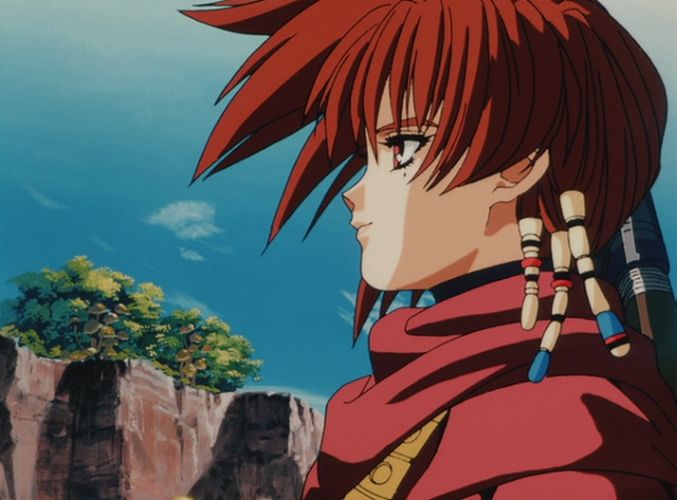
IMHO. 'Iria: Zeiram the Animation' ~ I know what screenshot will attract most viewers!

It's the main character Iria's breast and a cute unknown animal trying to get out from it, if you're wondering...
In fact you see, I could find many faults that I usually find in Japanese anime and TV dramas. After all, it's just one more story about greedy politicians whose research object went out of control, about immoral administration officials who take a monster invasion as a way to get rid of the slums, about self-sacrifice and friendship born out of rivalry, about how families are not necessarily people related by blood. Nothing new, one may say.
After thinking what makes it different, this is what I have to say.
It's the wonderfully beautiful world where an oriental pagoda is standing in front of some kind of an industrial tower with fictional technologies, where every scenery looks like you can go there the next moment
where citizens wear kimono-like clothes and policemen wear turbans
Where every costume of every main character is detailed and elaborate with many functional elements balanced by futuristic decorations
It's awfully good graphics for close-ups and pastel backrounds, even if some frames are less accurate. It's awfully great character design, with attractive girls and masculine guys, with stylish hair, defined pitch-black lashes and pink lips of the heroine.
It's the scary monster resembling a daunting samurai.
And before that, it's the good old style of story development. It's about strong heroines with personalities rather than flat patterns. Strong, and not ugly. And not big breasted women. And strong heroes. Not those 'I have to be strong', but really, literally strong. Big strong caring men. Versus disgusting monsters bringing many deaths.
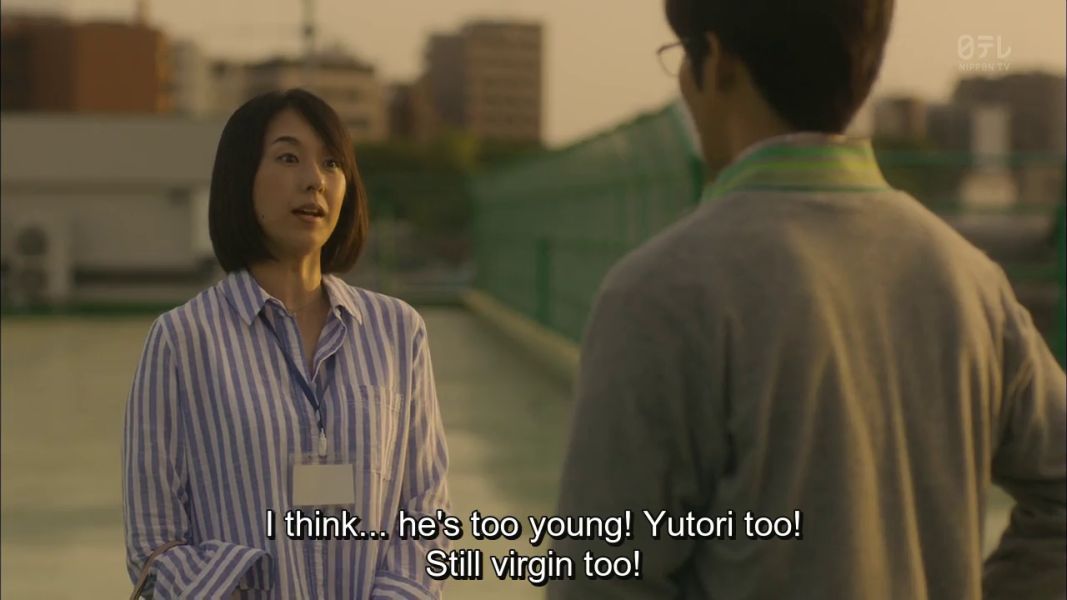
Now that I know better about the phenomenon of 'yutori', the young generation in the Japanese society who are supposed to be different from the older generations, I am going to put it in my reviews left, right, and centre.
A joke that might be, but I no longer hear such impressive voices among seiyuus in the newer anime series. Aya Hisakawa was so natural as the impulsive, energetic, fearless and optimistic Iria that you'd never say she is that Ami Mizuno or Chloe from 'Noir'. Juurota Kosugi is well... Wrap me some Kosugi for a take-out. Both Mika Kanai and Chika Sakamoto in their roles of orphan children were just classic. The partners of Iria by Masaru Ikeda and Shigeru Chiba were also good.
The opening and ending songs did not impress me much, but I did not dislike them.
It now seems as if 'Iria' is an ideal anime, but unfortunately that's not like it, and the problem is... time.
6 episodes per half an hour is something equal to 9 TV anime episodes, and I really miss the remaining 3. If there were more time and more episodes, the touching moments, the tragic moments would be properly done and leave the necessary lingering sadness. As a matter of fact, 'Iria' narration gets messy from time to time and even after catastrophic destruction or an important character's death or a hard battle the character switched back to normal rather quickly. At least it's not usually done with such a speed in anime.
I'd say, 'Iria' is not ideal, but it definitely set me back on track and gave me back the feeling of what's real, like a camertone. I want moar!
It's a cliche, I have said it too many times, but certainly the old anime series are generally better. I would like to say otherwise very much, but when I open MyAnimeList, I see titles like 'The Master of Ragnarok & Blesser of Einherjar' or even 'I Want You To Make a Disgusted Face and Show Me Your Underwear'.

13 August 2018

IMHO. 'Yutori desu ga nani ka' ~ yes, I have NANIKA to say

Fathers and sons, just like Turgenev said... What other topic can be more fertile for a producer to make a good modern TV drama?
Having too high hopes for a dorama has never proved a successful strategy for me, but again I run into the same trap. I was hoping so much to see a story about young people making their way into adult life, moreover the characters are only a couple of years me senior.
Instead of a tale about how yutori, the relaxed youth, differ from the previous generations, singing 'I want to break free', I got a story which, as most Japanese dorama do, reflects the older generation's ideal. Feels like the scenario was written by real old farts. Even if it wasn't.
It's a story about several yutori guys who aren't yutori. They technically are, by age, but aren't by nature. Instead of them, yutori are their juniors. And the main characters are name-only yutori dreaming of the good old days.
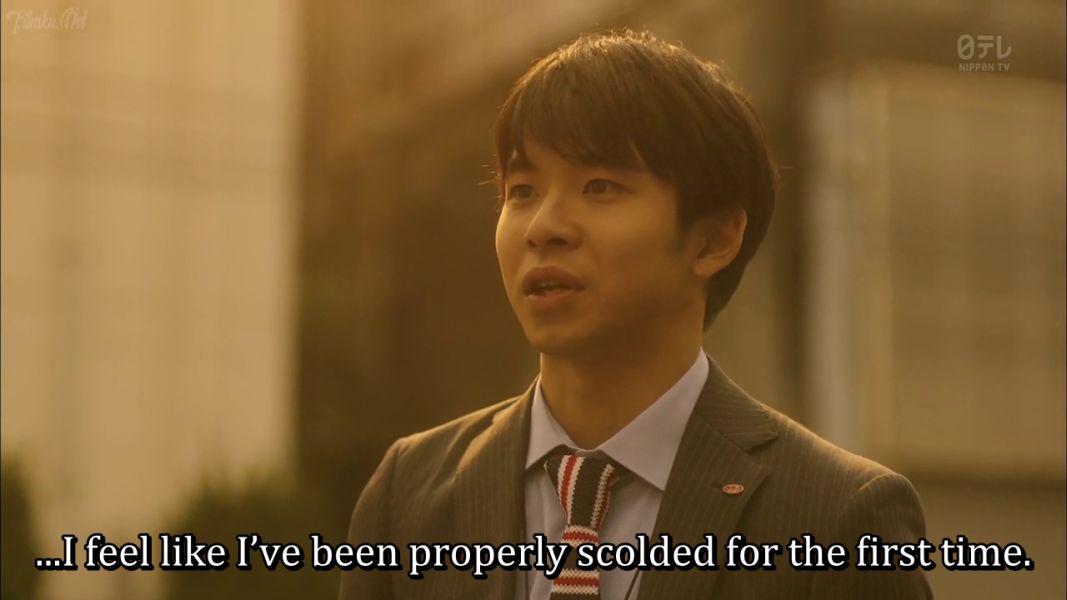
First, here is Sakama, a young man who entered a university that would let him enter, and is working in a company that would let him work. Sent to lead a local restaurant, even though he is now the head of the establishment, he puts on an apron and starts grilling meat, because that's the way it has been done for ages in Japan: no real experience - no managing. Who cares about his education, take the beer and bring it to the guests. However, he doesn't mind, since he stands for the old ways from the very beginning. He shouts at his junior colleague, when the latter makes a mistake, achieving the dream of every middle-aged manager in Japan - seeing his disciple look up at him and thank him for scolding.
He unexpectedly gets unfairly sued by the younger man for power harassment, but does not bring it to the court to defend himself, because such matters should be settled within the big family, which the company is.
Even if members of this family gossip and your boss occasionally sleeps with your girlfriend while you temporarily break up. Even though your girlfriend says you don't need to go that far.
Eventually Sakama and his junior reconcile and stay on good terms. Sakama then retires to help his family with the traditional craft of sake making. And even his girlfriend retires together with him and starts working in the family brewery too. Meanwhile, his older brother thinks of going to Hokkaido and starting agriculture business because he is not successful in impregnating his wife, but finally he manages to do it and remains the company head (erm... what?). And the younger sister finally finds a work to do. Several times it was shown she was trying a job to be proud of, unsuccessfully, but her brother tells her not to give up, because it's not decent not to work. But in the end she is shown as a novice employee who cannot understand the request of her customers. But that's okay, since she is doing her best right?
Much time is allotted to the main couple trying to settle their relationship, because our first-generation yutori wants to be as proper as he can, no matter he is supposed to be from the 'relaxed' generation.
And then, when his sweetheart is in doubt about her future, he just...
So, following the long-established Japanese way of living one's life, they fulfilled that 'work' and lived happily ever after, 'medetashi medetashi'.
Second, here is Yamaji, a teacher who occasionally inserts a word or two to protect the new 'yutori' system and show the good sides of it, such as children with learning disabilities being able to study together with other pupils. However, Yamaji follows Sakama's example. He, too, scolds his junior colleague out of love and even starts a relationship with her, after she several times let him down seriously and went out with other men. Yamaji was meant to be the comical element as well, but I am not sure whether to laugh or not.
The third, the one I was praying to stay sane in this whirlpool of upbringing madness, is Malibu, the happy-go-lucky owner of a 'kira-kira-name', a non-traditional name for a Japanese with a queer sound, obviously dedicated to a hot honeymoon of Malibu's parents somewhere in... Malibu. He was the only one not afraid to say how things exactly were without trying to cover any motive.
He made the characters realize how they were living their lives, even though his own way of living his life was not decent, at least in the eyes of society. Unfortunately, he was not a real yutori either. He, too, dreamt of being scolded properly by his father, who abandoned him and therefore did not raise him like he should, shouting and showing what's right and wrong. Mostly, what's wrong.
By the end, the only driving force for me to keep watching was the monstrous amount of mistakes in the English subtitles and the high level of difficulty of the original script. I'm really willing to translate, because it's such a challenge. The original text was not easy to understand not only by ear, but even when you have the script, despite what you could think when you watch an average dorama about young people in the modern world.
As for acting, there were some attempts to act on part of Masaki Okada, though I doubt Stanislavsky would ever approve. Sakura Ando was much better in her ingenuousness. Tori Matsuzaka was a blank space to me. He must be considered a real ikemen in Japan, I guess.
Yuuya Yagira was perfect, as if his character was created out of himself. I suddenly realised he was the actor who made an overwhelming impression on me as a young criminal in 'Lady - saigo no hanzai profile'.
Haruka Shimazaki was your average cutie girl, but if she thinks her squeaking voice is cute I'd love to disappoint her. I wasn't surprised to see she's an idol, in fact, I was half suspecting it.
Kotaro Yoshida played an extremely strange character, a dude you can hire to complain about your life, at the same moment being that bad dad who didn't raise Malibu. I couldn't care less about him, as well as all other characters like Sakama's family, colleagues, Akane's dad, mother of Yamaji's pupil and all the others.
Probably one of the best was Takumi Kitamura portraying an extreme variant of yutori - young, fashionable, brazen and stupid.
I did not notice any music there, and the opening theme by Kankaku Pierrot was disgusting in its mediocrity pretending to be philosophical.

07 August 2018

03 August 2018

IMHO. 'ShakespeaRe-Told ~ The taming of the shrew'

It's probably the fourth time I watch 'Taming of the shrew' as a movie or stage performance. And therefore it should be the fourth time I cannot make myself like this story.
The biggest problem is, I like very much stories about love growing out of  testing, probing, mocking, taunting, 'will you still love me and accept me if I do this?' and if yes, there comes happiness - but here, this is not the way of testing I find very attractive. One reason is that creating such problems as in 'Taming' is not the right form of doing that. 'But he does think the world of you in his own strange way', says the kind-hearted friend. But then you see, it's scary. Supposing that I am still single when I am 38, will I also be as desperate for sex to find just any man as to agree to such treatment?
The second reason, the main one is that I personally prefer give-and-take to just give-in. Up until the very end I couldn't find a single thing she would need in him. The submission is only glorious when it's mutual. And showing the worst of you is only justified when you devote yourself to delivering the best.
Oh yes, Henderson and Sewell were absolutely great, and it's rare to see a performance like that, but then, I didn't care for a second whether their characters would be happy or not.

02 August 2018

IMHO. 'Eleventh hour' ~ when I can't do without subs

Give me back the British pronunciation, I was thinking all the while. What a wonderful sine wave would a graph of my self-esteem make when I watch an American movie after a British. It was not that bad, no, not at all, but considering how many scientific and investigation terms were used, I'd never appreciate the series without subs, which, for some reason, were only present for some of the episodes, not all, at least the time-matching ones...
Apart from some new words learned, what kept me watching was perhaps only the presence of Sewell. He is just as irresistible as ever. Oh, and perhaps mister Omar Benson Miller. I really wish there were more of him, such a lovable character with such a nice attitude and cute smile. Was it the producers' mistake to have found him too late?
Well, they helped me go through the whole 18 episodes of a not-so-interesting... what? mystery? Here is the moment when the Russian word is more precise. We call such stories 'detective stories', while English sources would say it's 'mystery'. And while certainly it's detective, not much of a mystery was there.
I thought mystery is when you don't know the essence of the crime and the criminal's motive for the most part of the episode. It's common, even though it can get boring, when the criminals are caught in the end and only then confess why and what they did exactly. It's also a nice way of story-building when the criminal is smart and keeps outwitting the detectives. How am I supposed to get hooked when the reason behind the sudden bad symptoms is uncovered almost instantly by Dr. Hood? The rest is simply about whether it was caused by this or that reaction or substance. Chemistry, biology and all kinds of scientific explanations are great, but you see, none made me more interested in science than I already am. Was it caused by repellent or pesticide? I don't really care. I would care, though, if there weren't so many white spots in each plot. Some details were finally left non-discussed and unexplained. Even though they might have found the substance and the perpetrator, there were episodes in which some reactions were left unexplained, such as why one girl in the family didn't get sick while she claimed to have eaten the same things, or why none of the crew reacted to the bad pheromone in the fragrance, since the difference between those affected and non-affected was not stated.
Not many of the criminals were impressive either, with no really interesting stories about their past. Not many victims, though, excited my sympathy on the other hand. The only one who managed to do that was the wife of the tv reporter who lost his sight in the helicopter and crashed, played by Susan May Pratt.
Speaking of victims, I must also notice that Sewell's portrayal of a man who experienced loss is, just as you would expect, impressive. It must sound rude, I know, but it's as if he was born to express grief...
As for the main duet, it was okay I guess? Might have been better? Maybe. I think I was rather satisfied than not. You see, Marley Shelton was not very enchanting, but then - was an FBI agent supposed to be?
Well then, as for the scientific part, it was generally all right, but I didn't quite like that science looked rather dangerous frequently throughout the series. Even though I want to thank the creators for showing that the guilty are only those who abuse scientific research, I can totally imagine people saying 'here, that's why I'm not eating GMO' and so on.
The one good moment: Hood saying a memorable phrase 'if immortality is outlawed, then only the outlaws will be immortal'. Yes, that was impressive.
The one bad moment: the episode about heavy water. It was obvious the scenario was based around that 'miracle' concept. I knew that while Hood was trying to prove there aren't any miracles, the story would still assert there are. And yes, it did. So, 'if that storm didn't hit, the boy would have his tumor, and the region would be blasted with a dirty bomb'. And Rachel would call it a miracle. Well you see, it's not a miracle. It's a coincidence, with a chance of happening that can be predicted with more or less accuracy. Yes, it's a miraculous coincidence, but nothing more. Ending the episode with such conclusions makes people hope for more miracles, and those won't happen more than their probability is. I just had to say this. I almost hated the episode.
Otherwise, the story was not bad, but it's surely not a series I will miss.

04 July 2018

IMHO. Chicane

I seem to be too young to remember the first albums of Chicane, as I read on some forum thread, in 2009 he was told to 'no more produce the same quality albums', but I was surprised to find some hits I know very well are created by him
like 'Don't give up'
or 'Low sun'
or 'No ordinary morning'
on the other hand, they weren't the reason I came. It was 'Running to the sea' from the latest album.
While getting to know Chicane closer, I discovered a strange trend - only a couple of songs in each album were exceptionally impressive, the rest were only average. Among those were some really good, but the repetitive style got me bored very quick.
Some were reminiscent of the era, like 'Some might say' which sounds almost Daft-Punkish
But in the end, my favourites would be those creating a mystical, ethereal environment, especially magical inside of the fresh June verdure.
'Saltwater', based on Clannad's 'Theme from Harry's Game' which I have already heard on a bootleg CD with songs supposedly by Enya while they actually weren't...
 and 'Windbreaks'. These require no comment, I swear.
 

04 June 2018

associations. Schroeder-Headz and The Cinematic Orchestra

'Nocturne' by Schroeder-Headz and 'To build a home' by The Cinematic Orchestra.
I mean, the intro, the intro!

IMHO. Fake? - why did I ever decide to give them a try?

'why did I ever decide to give them a try?' - I was thinking when I listened through the whole discography and found only 7 songs that were at least interesting.
Then I opened my YouTube history and remembered what I thought upon hearing them for the first time. 'These songs are not very impressive, but they are listenable and I might find something good if I listen to the rest of their songs'.
So, it seems the so-so songs I heard were probably the best I could find among more than a hundred of songs Fake? ever issued.
Wiki says they even produced a song "Care" in collaboration with Kokia... If I weren't told there is female vocal in there, I wouldn't even notice it. If I weren't told it's Kokia I wouldn't recognise her. I can only laugh now that I know this fact... What an impressive vocal! How much it changed the song atmosphere! LOL
And this is Kokia, with her outstanding talent and unique aura...... >____<
In the end, the only listenable songs were:
Taste it
Mad Hatz' Merry Go Round
Serial killa
Forgive
White rabbit inc
Beside me pink and purple
Two hearts
Probably the only fact that make these songs stand out is the heavier use of electronic sound... The rest are so alike and so plaintive and dismal, I'm tired of listening to them.

02 May 2018

IMHO. Moon Troupe's 'Company' and 'Baddy'

For some reason in a while I felt like writing a detailed list of my impressions of the show...
First, 'Company'.
Probably the first time in my life I watched a musical and felt unsatisfied. My love for Moon Troupe did not let me admit it but let's face the truth: this is weak. What's with that story? Everybody works hard, there are some collisions during the process, but in the end they find common ground and make the show a success. 'cause 'audience are partners of the performers' huh?
I was surprised to find the show is based on an existing novel, so shallow the concept was.
If the above summary is just too short, here is a short but comprehensive one:
After two companies merge into one, several events are set up to promote the new company's image. Your average 'sarariman' Aoyagi tries to stand up for a young sports trainer Yui who is blamed for bad handling her duties, but in the end they both are transferred to produce a ballet performance, just as one would expect haha. During preparations they meet actual ballet dancers, Aoyagi learns much from his new friend Minami, Yui tries to establish partner relationship with a renown ballet dancer Takano who is a star both in Japan and abroad and has his own views on how things should go in life. The president's daughter Sara who is the prima of the ballet troupe constantly appears on stage and does nothing in particular. Dancers and teachers from the ballet school supported by the corporation also appear and do pretty nothing. Nayuta, a young singer from a famous band, is suddenly chosen for the main role instead of Takano who confessed he is not in his perfect condition. This condition however doesn't prevent him from dancing not only the bad wizard Rothbart but also Odille who is changed from a female role into a male one, being an apparition created by Rothbart...... What? Well, many characters asked the same, but in the end everyone agreed. Of course everything cannot go perfectly and Sara gets injured when being lifted by Nayuta, but everyone is yasashii and says it was her fault and not Nayuta's. We didn't even for a moment doubt Sara would somehow be dismissed from the show because Minami, who is her understudy, could not possibly stay behind the curtains since she is the one played by the Top musume. She is afraid to perform, but Aoyagi, who was afraid himself just a couple of minutes ago, comforts her and they embrace. By the way, Takano also had problems because he supported the injured Sara, but he has his devoted trainer Yui, heheeey! So, the last ballet performance is a success despite the problems, Takano decides to establish some kind of agency in Europe and suggests Yui go with him, now you girls should learn to be as persistent as Yui had been, and don't forget to wear a lovely blue dress for the party to conquer a stubborn guy's heart. The Top duo is together, of course, and everything is well......
I personally love funny stories with happy ending very much but I was not sure in the end if I wouldn't like to have a pickled cucumber.
Aoyagi by Ryou Tamaki is that average 'sarariman' doing his job diligently. Suddenly transferred from sales to ballet producing? Not a problem. They still think in Japan that a good worker should try everything in every section and be ready for anything. Doesn't matter he doesn't know anything about ballet - he just needs to learn... Despite - or thanks to this story flaw - I don't know which one it is, but Aoyagi was the same good guy till the end. Maybe the best thing I learned from him was that Natsume Soseki translated 'I love you' as 'tonight moon is beautiful', because the Japanese prefer indirect speaking.
By the way, I noticed that in the original Aoyagi's wife was not dead from cancer but rather simply left him. As for me, I'd rather leave this fact as it was in the book. At least it would add some nuances to Aoyagi's character.
Young ballet dancer Minami by Reika Manaki was your avegare cute and positive, slightly dumb girl. Only slightly... Well, they like it very much in Japan when the girl doesn't get it when she is confessed to. And it was even cute, when performed by Chapi. And still, what else can we expect from such dull characters, even if they are played by the Top duo.
Probably Miya's ballet star Takano was the only noticeable character in the story. The proud celebrity with his own stance and views, moreover with character development not much seen in anyone else in the story. I was waiting so much that he would attack his cute trainer and supporter, Yui, by Mitsuki Umino. This is probably bordering on an otome's fantasies, but what can I do if Rurika is not only a good actress but also such a hot thing too. For want of hotness in all other characters, I guess I would be happy if she attacked just any girl on the stage... But I had to be satisfied at least with the fact that Takano invited Yui to be his trainer and manager in Europe.
Speaking of the much desired hotness, at least Hayate Uzuki as the pop-group leader Akutsu was trying to add some, and I'm sure she would if her time on stage was not so limited. I'm not sure if it's right to measure the quality of a performance by the level of 'presence', but Uzuki's presence was big and one cannot ignore it. Even the scene where her character simply apologizes for his fellow band member was more impressive than many other longer scenes.
The same goes for Yurino Touka as ballet teacher Noa. Her role was small but she was good in it and even managed to pull some gags. Both Seri Ayazuki and Ruu Kozuki were also good as the wise company head and the funny manager who was constantly getting angry but in the end turned to be the only one 'restructured' - away from the company for good.
Wakaba Saotome as Sara was not really impressive to my taste. Chisei Akatsuki was not either, but at least she did some beautiful pas during the 'Swan lake' play within a play.
Kanato Tsukishiro........ Now here is something to think about. I didn't like her in 'All for one', but I admitted it might have been my personal prejudice. In 'Company' however I totally forgot about her existence in the Troupe and only noted how bad Nayuta was performing and singing. Even then I didn't recognise her. Finally I recalled she must have been somewhere in the Troupe, and by process of elimination I guessed it must have been her. Even then I didn't believe it and even double checked the role list. So, yes, she was really bad. Her acting was flat and all the important moments looked too deliberate, and her part in the 'Barbarian' band performance was not very good. While I could tolerate some other actresses I don't like, when it comes to Tsukishiro I cannot help thinking what she is doing in this troupe, and why.
And just one actress I would like to mention is a girl whom I didn't recognise and whom I really will have to check on! One of the ballet dancers was given a short aria when Aoyagi came to the school, and that was just a-w-e-s-o-m-e.
I also must praise that actresses acting as ballet dancers were actually performing ballet on the stage, and Manaki was even standing en pointes.

'Baddy'
probably compensated for everything lacking in 'Company'. This is the case when the revue is better than the first half.

A not-so-short summary (and yes, this revue has that what can be summarised):
On Earth, in a kingdom where all people are good and go to heaven after death, the prince and the princess of the royal family are admiring the Moon through a telescope, even though Moon is a big prison. They notice an explosion, which was supposedly caused by a notorious criminal called Baddy and his company of 'bad guys' (he is Baddy because he is bad, but you've surely noticed how this word reminds of 'buddy', a friend, colleague or member of a company). The policewoman, Goody, is looking after peace of Earth together with her supporters, including a broken-hearted guy who seeks her attention. When a quarrel is about to happen between the king and the queen, Goody helps settle it. Then, Baddy arrives with his followers, including his Sweetheart of an unknown sex (just when you think whether it be him or her, the characters explain that it's impossible to tell - and you settle down with it, haha). They start their adventures by breaking the ban on smoking. Goody tries to arrest Baddy several times, the most prominent one - during a presentation of seafood, where she pretends to be a scallop... o___O In a skirmish one of Baddy's followers is wounded, but the princess lends him her handkerchief, which marks the start of their relationship. Goody's friend ends up in the Baddy's quarters, where he learns evil and discovers his talent for passport forging. The bad guys sing and dance explaining how to be bad by extorting money from rich women, with some of them successful, some - not so much, and one of the followers, meeting the kind-hearted princess, refusing to take any money at all. When trying to capture Baddy, Goody learns about her friend changing sides, she then leaves the main target be and pursues her friend. Baddy suddenly realises he is offended by this, meanwhile Sweetheart notices this growing interest of Baddy and grieves he is no longer the 'dynamic and dangerous' man she (he?) admired. The royal family makes a deal with aliens about keeping some valuables in their bank, this decision overheard by Baddy. He then reminds himself he is kinda bad and decides to steal the treasure. Wearing a wig and pretending to be one of the aliens, he lures the code from another banker and removes the whole safe together with the prince and the princess on the platform. Goody, who was about to fall for Baddy's charm, realises she feels humiliated and outraged by this, and decides to pursue the bad company to another planet where they have fled. After a large-scale fight the children are rescued, but the friend of Goody is shot. He dies in the arms of Sweetheart, who says he is the real 'dynamic and dangerous' guy. All others manage to escape, but Goody and Baddy, though stick with their principles, cannot let go of each other, and it is said they never returned from that planet. Some time later they are seen in heaven, where Baddy finds himself surprised to be, and upon hearing the fact he hurries up to start smoking. By the way, the role of the cigarettes is played by the indispensable shan-shan.

If you could help me find the right word to describe it, I would appreciate it, but for the lack of it I should call it 'trippy'. The fantasy setting, the crazy costumes, the weird concept of all the characters, the bad Baddy and the cute Goody, and androgynous Sweetheart, the grey-faced aliens-bankers, the good guy suddenly discovering his talent for forging passports, the dance of the seafoods... The number with Goody and cancan girls dancing to the song describing her hatred and determination was one of the best musumeyaku numbers I have seen in my life. And finally, the energetic otokoyaku dance and passionate dance of the Top combi make up greatly for the dullness of the musical. If you wanted hotness here is some. One important correction: I don't and I never will recognise Tamaki as a cool character or a 'bad' one. Villainous villains are out of her way. The first half of the show was partially unclear to me until I saw some development in Baddy that led to the ending as it was.
To my relief, there were good songs and melodies in the revue, and singing of all performers was very good with some parts really difficult. Now that I recall the revue, it was probably the most strange, unusual, unique revues I've seen - and I like it! The costumes were also different from what you'd expect, and I insist they were very beautiful.
It's not very good, maybe, that I haven't been watching much of Takarazuka lately, but this gap enabled me to appreciate how Tamaki and Chapi have grown as performers - as actors, as dancers, and as singers, which impressed me most.
p. s. I must mention Rurika's Sweetheart again. With every performance I respect her more and more. While I didn't like her face very much it might have influenced my general opinion of her, but her charisma reaches the farthest rows of seats so easily, her characters stand out so much, her presence is so big that I started to feel admiration for her without realising it.
If I could have a ticket for half price and see only the revue, I would go to watch 'Baddy' again!